 01772 822626
 Email Us
 Find Us
 Get a Quote or Start a Chat
 Home
Home What We Do
 Reviews
 Case Studies
 About Us
 FAQs
FAQs We Also Visit
 Blog
Blog Contact Us
When you focus on improving search performance, some things you might be recommended to monitor include keywords, backlinks and technical audits. However, if you want sustainable results, you need to look beyond isolated tactics. This includes understanding the user journey, which allows you to see your website as your audience does. But how does understanding the user journey improve SEO? And why should you build your SEO strategy around this?
What is the user journey?
The user journey describes the steps someone takes from the moment they become aware of a need to the point where they take action. This action could be making a purchase, submitting an enquiry, signing up for a newsletter or simply finding a clear answer. In practical terms, you can think of the journey in stages:
- Awareness: Your audience realises you have a problem or question.
- Consideration: Your audience compares options and looks for detailed information.
- Decision: Your audience chooses a solution and takes action.
- Post-decision: Your audience evaluates their experience and may return or recommend.
When you understand these stages, you stop creating content only to “rank” and start creating content to serve specific intentions.
You match search intent more accurately
Search engines are designed to deliver the most relevant results for a given query. If you understand where someone is in their journey, you can tailor your content to match their intent more precisely.
For example, when someone searches for “what is important for web design?”, they are likely at the awareness stage. They need a clear explanation. If you instead push a sales-heavy page encouraging them to “buy now”, you create friction. Search engines will notice poor engagement signals such as short dwell time or high bounce rates.
On the other hand, when someone searches for “web design in Lytham”, they are likely comparing options. In this case, you should provide transparent benefits and evidence-based insights.
By aligning your content with intent, you improve engagement metrics. In turn, these behavioural signals support stronger organic performance.
You build content that serves real needs
When you map the user journey, you uncover gaps. You may realise you have multiple service pages but no helpful guides for early-stage questions. Or you may discover that you attract traffic but do not support users who are ready to convert.
This insight helps you create content clusters that guide users logically from one stage to the next. Instead of isolated blog posts, you develop a connected system, including:
- Informational articles for awareness.
- In-depth resources and case studies for consideration.
- Clear landing pages for decision-making.
- FAQs and support content for post-purchase reassurance.
When your site reflects the full journey, you reduce drop-offs. Users find what they need at every step, and search engines interpret this coherence as topical authority.
You improve site structure and internal linking
Understanding the journey is not only about content themes. It also shapes how you structure your site. If you know that users typically begin with broad questions and then move to specific solutions, you can design intuitive pathways. You can use internal links to guide them naturally from an educational blog post to a related service page. This improves crawlability and distributes authority across your site.
From an SEO perspective, clear structure helps search engines understand relationships between pages. From a user perspective, it reduces frustration. When visitors do not need to search repeatedly for the next step, they stay longer and engage more deeply.
You increase engagement and reduce friction
Search engines increasingly evaluate user experience as part of ranking systems. While algorithms are complex, the principle is simple: if users find value, your visibility improves over time.
When you understand the user journey, you can remove friction points. You might notice that your contact form appears too early in the journey, before trust is established. Or you may identify that key information is buried behind vague headings.
By refining page layout, calls to action and supporting content, you make the journey smoother. Users feel understood rather than pressured. This often results in:
- Longer session durations.
- Lower bounce rates.
- Higher conversion rates.
- More repeat visits.
All of these outcomes contribute indirectly to stronger SEO performance.
You create people-first content
A people-first approach means you prioritise clarity, usefulness and authenticity over keyword density or manipulation. Understanding the user journey naturally leads you in this direction.
When you write with a specific stage in mind, you avoid stuffing keywords into generic text. Instead, you answer real questions in straightforward language. You anticipate concerns. You provide context. You explain processes transparently.
This approach aligns with current search engine guidance, which emphasises helpful content created for people rather than algorithms. When you genuinely solve problems, optimisation becomes more strategic and less mechanical.
You build long-term authority
SEO is not only about ranking for individual queries. It is about building authority within a topic area.
When you understand how users move through a journey, you can identify recurring themes and related subtopics. Over time, you produce comprehensive coverage that signals expertise. Search engines recognise that your site does not simply target isolated keywords but supports users throughout their decision-making process.
This consistency strengthens brand trust as well. When users repeatedly find clear, reliable information on your site, they are more likely to return and recommend you. Brand searches and direct traffic can increase, reinforcing your overall visibility.
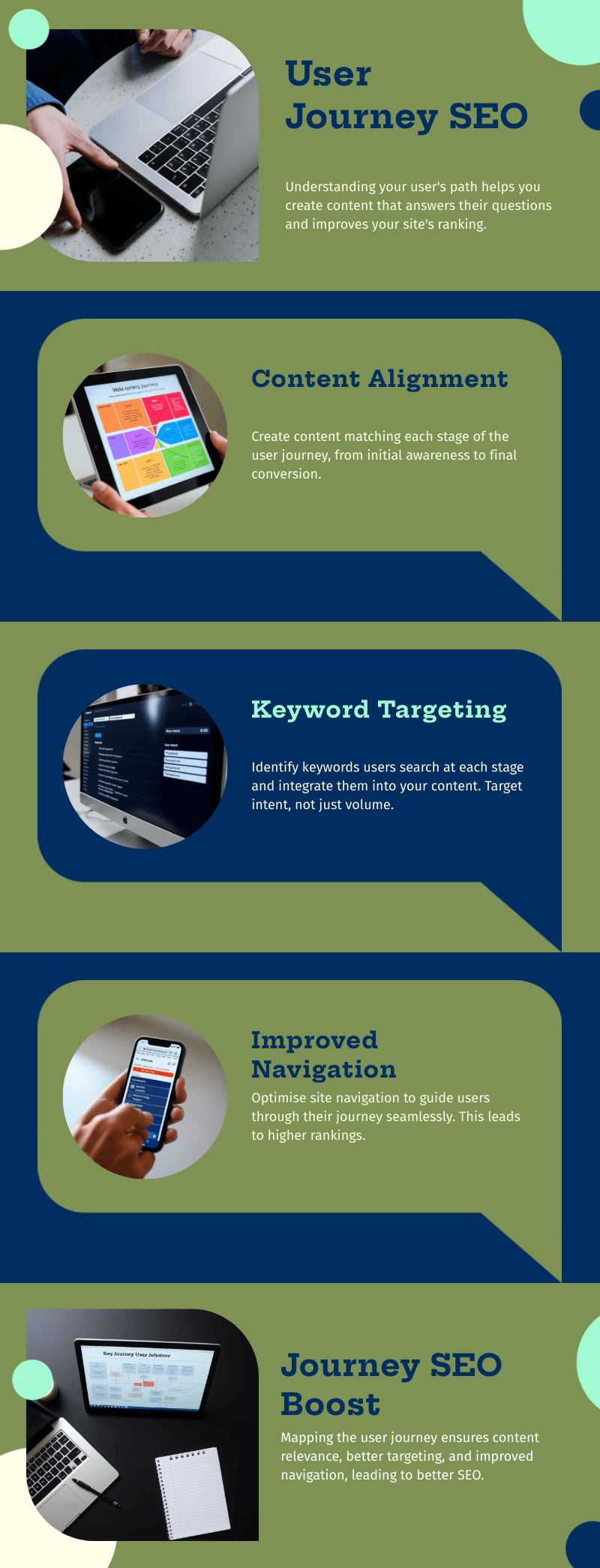
So, how does understanding the user journey improve SEO?
Understanding the user journey ensures that your SEO strategy supports measurable outcomes. Traffic alone is not enough. You need qualified visitors who are likely to take meaningful action.
By mapping content to journey stages, you can identify which pages attract early interest and which drive conversions. This clarity helps you refine your optimisation priorities. You can then invest in content that not only ranks but also moves users forward.
Here at Pumpkin Web Design we are Preston’s leading web design and web marketing professionals. We provide a wide range of website solutions and SEO services across Preston and the North West, from Blackburn and Bolton, to Southport, Wigan, and even Manchester. We work with businesses of all sizes and across a wide variety of sectors, from local service providers to established commercial brands. So, for more information about SEO, content marketing, traffic growth and web design, get in touch with the experts at Pumpkin Web Design today.