 01772 822626
 Email Us
 Find Us
 Get a Quote or Start a Chat
 Home
Home What We Do
 Reviews
 Case Studies
 About Us
 FAQs
FAQs We Also Visit
 Blog
Blog Contact Us
While traditional search engines like Google remain important, more users are now turning to AI-powered search tools and assistants to find information, compare products, research services, and make purchasing decisions. As a result, you might have noticed that your website is receiving increasing amounts of traffic from AI search platforms. Although this is great for your visibility and branding, these visitors are often arriving on your website with different expectations and behaviours compared to traditional search users. So how can you audit website content for AI arrivals? And how can you convert this additional traffic into paying customers or clients?
Why are websites getting more traffic from AI search?
AI-powered search tools are becoming a popular way for users to find information online. Rather than entering a few keywords into a search engine, users can ask complete questions and receive detailed responses, even having a full conversation with follow up questions.
These tools then often recommend websites, cite sources, and direct users to specific pages that provide useful information. As a result, as AI adoption continues to grow, businesses are seeing more website visitors arriving from these platforms.
How are AI searchers different?
One of the biggest differences is the way users search. Research and industry observations show that AI-generated search queries are often up to three times longer than traditional searches. Instead of searching for “kitchen designer Preston“, a user might ask:
“Which kitchen design company in Preston offers contemporary kitchens for small family homes and provides installation services?”
This level of detail reveals much more about the user’s intent, their requirements, and where they are in the buying journey.
What do these longer AI search queries mean for your website?
Longer search queries tell us that users are looking for specific answers rather than general information. As such, when someone arrives on your website from an AI search result, they are often:
- Researching a particular problem
- Comparing solutions or providers
- Looking for expert guidance
- Seeking reassurance before making a purchase
- Wanting immediate answers to detailed questions
This means your website content needs to be more comprehensive, more helpful, and better structured than ever before.
It also means that pages that only provide a brief overview of a topic may struggle to satisfy these visitors. Instead, users increasingly expect detailed information that demonstrates expertise and answers their questions without requiring further searching.
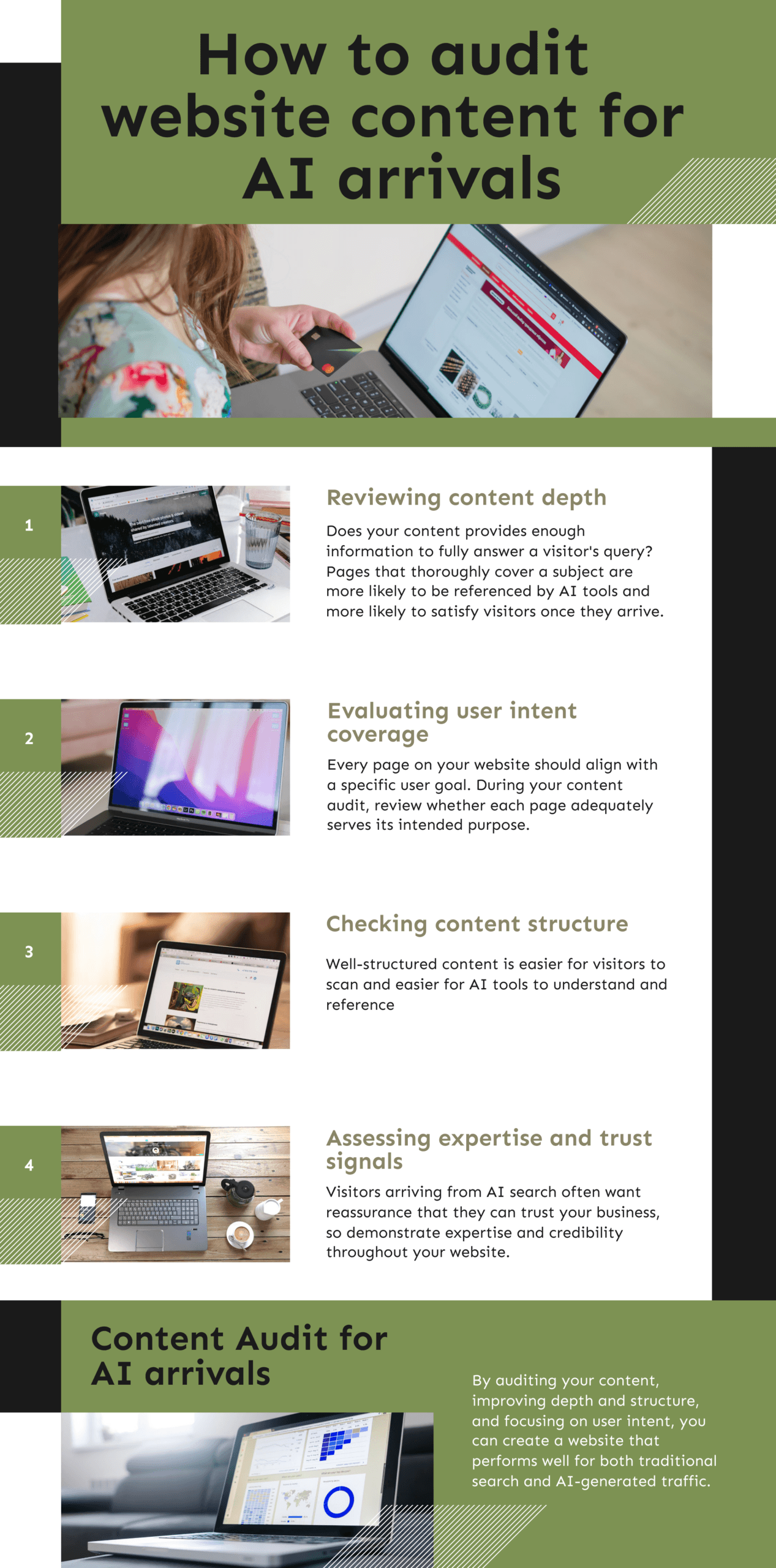
So how can you audit your website content for AI arrivals?
There are several important areas to review when auditing your website for AI-generated traffic. These include:
- Reviewing content depth
- Evaluating user intent coverage
- Checking content structure
- Assessing expertise and trust signals
Reviewing content depth
One of the first things to assess is whether your content provides enough information to fully answer a visitor’s query. Many websites were originally written to target shorter keyword phrases. As a result, pages can sometimes feel thin or incomplete when viewed through the lens of modern AI search behaviour. When auditing content, ask yourself:
- Does this page fully answer the topic?
- Are there common customer questions missing?
- Could a visitor make a decision using only the information on this page?
- Are there opportunities to expand sections with more detail?
Pages that thoroughly cover a subject are more likely to be referenced by AI tools and more likely to satisfy visitors once they arrive.
Evaluating user intent coverage
Understanding user intent is essential for AI search success. Every page on your website should align with a specific user goal. For example:
- Informational intent- Visitors looking to learn about a topic.
- Commercial intent- Users comparing services or products.
- Transactional intent- Visitors ready to make an enquiry or purchase.
- Navigational intent- Users searching for a specific business or brand.
During your content audit, review whether each page adequately serves its intended purpose. You should also consider whether your content answers the types of detailed questions users are now asking through AI platforms. FAQ sections, supporting content, and in-depth explanations can all help strengthen intent coverage.
Checking content structure
Content structure has become increasingly important for both users and AI systems. This is because well-structured content is easier for visitors to scan and easier for AI tools to understand and reference. So when reviewing your content, check that pages include:
- Clear page titles
- Logical heading structures
- Short paragraphs
- Descriptive subheadings
- Bullet point lists where appropriate
- Frequently asked questions
Assessing expertise and trust signals
AI search tools often prioritise content that demonstrates expertise, authority, and trustworthiness. As a result, your content audit should include a review of trust signals across your website. These might include:
- Author information
- Customer testimonials and reviews
- Case studies
- Industry accreditations
- Awards and certifications
- Contact details and company information
Visitors arriving from AI search often want reassurance that they can trust your business. By demonstrating expertise and credibility throughout your website, you can help improve engagement and conversions.
What are the benefits of auditing content for AI arrivals?
There are a number of advantages to preparing your website for AI-generated traffic. These include:
- Improved user engagement: When visitors quickly find the information they need, they are more likely to stay on your website and explore additional pages. Content that directly answers detailed questions helps reduce frustration and improves the overall user experience.
- Better conversion rates: Visitors arriving from AI search often have a strong sense of what they are looking for. So by providing comprehensive and relevant information, you can help them move more confidently towards making an enquiry or purchase.
- Increased visibility: Content that is detailed, trustworthy, and well-structured is more likely to be referenced by AI search platforms and traditional search engines alike. This can increase your visibility and drive additional traffic from multiple sources.
- Future-proofing your website: AI search is continuing to evolve, and businesses that adapt early are likely to benefit over the long term. Regular content audits help ensure that your website remains relevant, useful, and aligned with changing search behaviours.
What are the best practices for auditing website content for AI search?
If you’re planning to review your website content, there are several best practices to follow:
Focus on answering real customer questions: Use customer enquiries, sales conversations, and support requests as inspiration for content updates.
Expand thin content: Add useful detail where necessary without creating unnecessary filler.
Update outdated information: Ensure all facts, statistics, and service details remain accurate.
Improve content structure: Use headings, lists, and FAQs to make information easy to consume.
Demonstrate expertise: Include evidence of your experience, knowledge, and credibility throughout your website.
Review regularly: Search behaviour continues to evolve, so content audits should become an ongoing process.
As AI search continues to influence the way people find information online, you should make sure that your website is ready to meet changing user expectations. By auditing your content, improving depth and structure, and focusing on user intent, you can create a website that performs well for both traditional search and AI-generated traffic.
For more information about SEO, get in touch with the experts today, here at Pumpkin Web Design. We are Preston’s leading web design and web marketing professionals. We provide a wide range of website solutions and SEO services across Preston and the North West, from Blackburn and Bolton, to Southport, Wigan, and even Manchester. We work with businesses of all sizes and across a wide variety of sectors, from local service providers to established commercial brands. So, for more information about SEO, content marketing, traffic growth and web design, get in touch with the experts at Pumpkin Web Design today.